Dip, cool or steam? Clean Start treatments for Thrips parvispinus

This post written by Ashley Summerfield (M.Sc.), Senior Research Technician in the Biocontrol Lab at the Vineland Research and Innovation Centre.
They say that “an ounce of prevention is worth a pound of the cure” and nowhere is this truer than in IPM. Reducing the incoming number of invading pests will inevitably improve the success of any pest management strategy.
This post covers recent research advances made by Vineland Research on treatments of propagative plant material to help control Thrips parvisipinus. This includes effects of treatments on all thrips life stages, including eggs, as well as potential phytotoxicity of treatments on tropical plants.
This post also includes a link to the recent webinar on starting clean for Parvi recorded by Flowers Canada Growers, if you prefer that format!
Advances in “Clean Start” for Thrips parvispinus
Recently, researchers at Vineland Research and Innovation Centre, AFFC and OMAFA recorded a 3-part webinar series on advancements in IPM for Parvi. These recordings can be found on the Focus ON Floriculture YouTube page.
This first webinar covered effective treatments for propagative material, including unrooted cuttings (URCs) or rooted liners. If you don’t have time to watch the webinar, the blog post below covers the key points. Make sure to bookmark this post for next year’s cutting season!
Why Dip Your Cuttings?
Cutting dips have become an established practice for many ornamental crops in Ontario to reduce pests that hitch a ride on incoming plant material (see Potted Chrysanthemums 2024: Dips, Thrips, and Threats ). The most recent of these invaders is Thrips parvispinus (or ‘Parvi’ as we like to call it), which is often found on imported tropical crops.
Initial work on cutting dips focused on Bemisia whiteflies (Bemisia tabaci) on poinsettias. Given how successful this was, research was then expanded to western flower thrips (Frankliniella occidentalis, ‘WFT’) on mums and spring annuals. Over the past two years, Vineland Research and Innovation Centre (‘Vineland’) has been continuing their research on dips to include Parvi and some of its favourite hosts.
Which dips are currently registered in Canada?
Although Vineland tested many different products, of these, only Suffoil-X, BioCeres WP, and BotaniGard WP have dipping on the label.
Kopa insecticidal soap and Landscape oil are also registered for cutting dips, but these were not included in the current round of trials as previous research showed that Kopa was ineffective for WFT, and Landscape oil was more likely to cause phytotoxicity on sensitive crops than Suffoil-X.
Which dips work best for Parvi?
When testing dips against immature thrips stages, all dips tested had some effect on larvae, with the Beauveria bassiana products performing well across the board. At the top of the pack were BotaniGard ES, BioCeres EC, and BioCeres WP which reduced the number of thrips by 97%, 96%, and 86% respectively (no statistical difference between the three).
Dips worked less well for eggs, which is to be expected as they are concealed within the leaf tissue and therefore more protected. Only 3 products successfully reduced the number of eggs that hatched out – Suffoil-X (5ml/L), KleenGrow (1ml/L), and BioCeres EC reduced thrips larvae by 66%, 58%, and 35%, respectively.
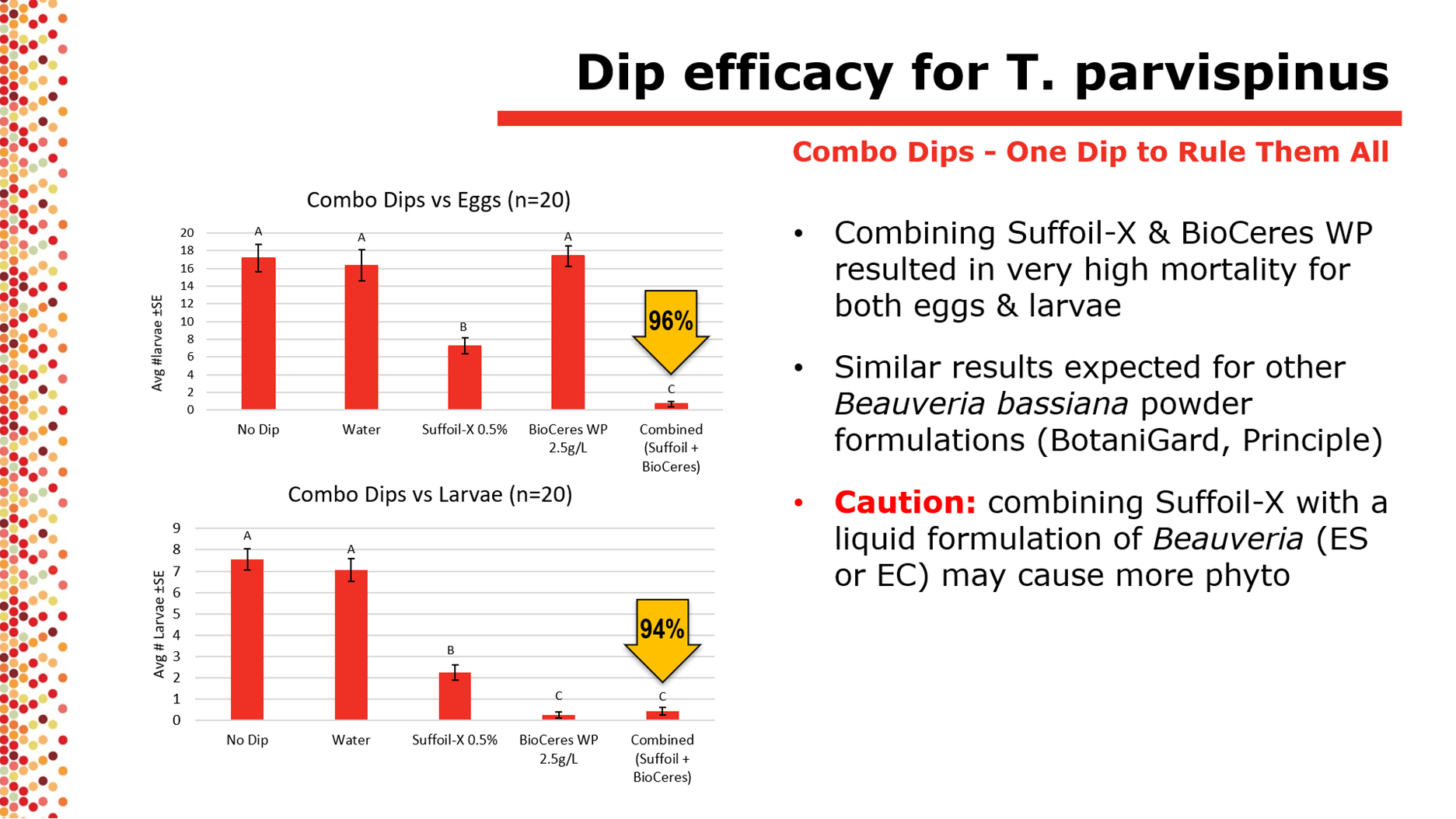
A combination treatment of Suffoil-X (5ml/L) and BioCeres WP was tested to try to find a dip combination that would be able to control eggs and larvae, which proved highly effective for both life stages. (Fig. 1). Note: always make sure to follow Health Canada’s tank mixing permissibility guidelines when it comes to tank mixing.
What are the risks of dipping?
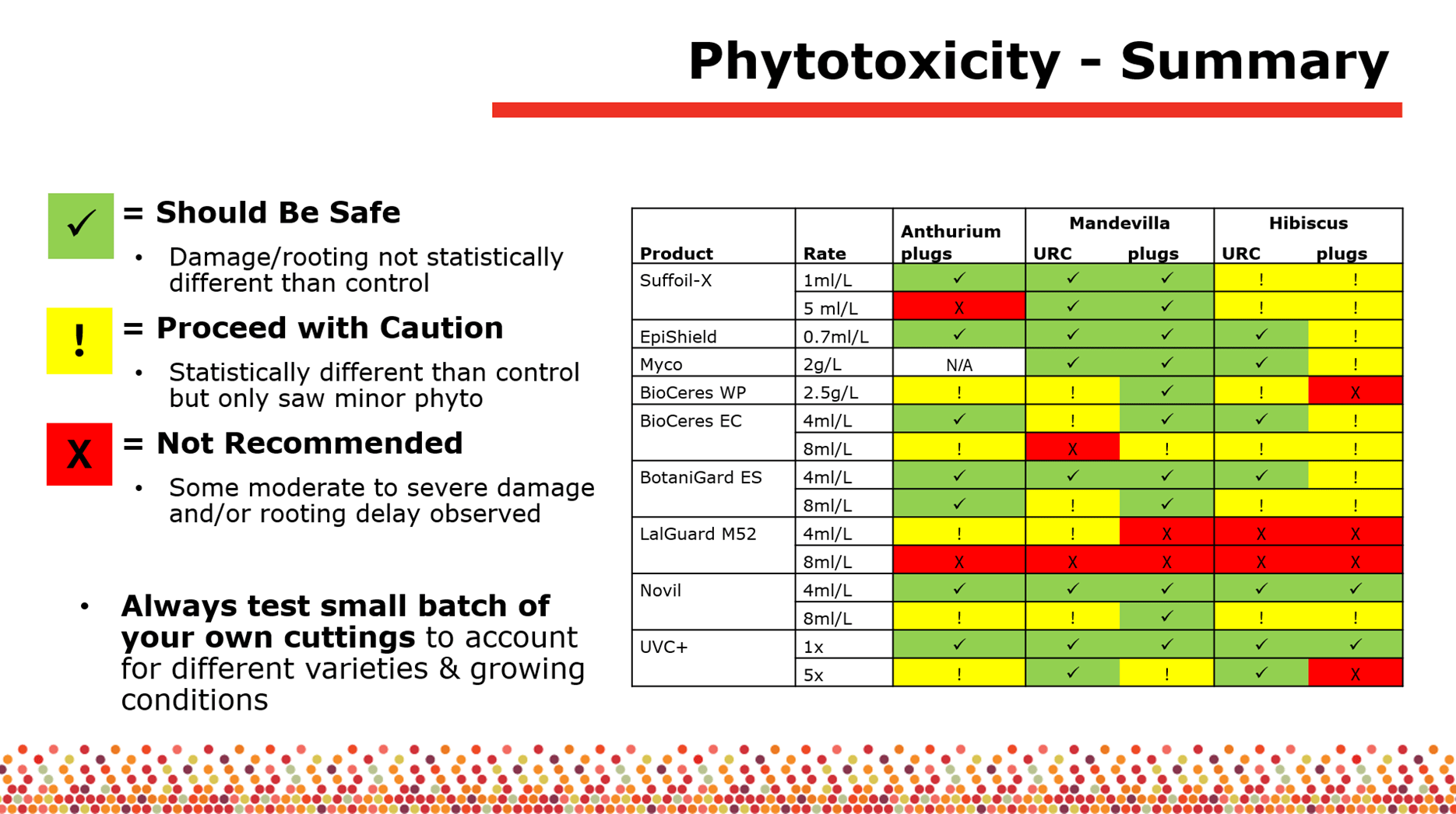
We tested 13 different cutting dip treatments for phytotoxicity on 2 varieties of Mandevilla (‘Grande Red’ and ‘Raspberry Splash’) and 1 variety of Hibiscus (‘Adonicus Pink’). In addition to the unrooted cuttings, dips were also tested on rooted plugs of Mandevilla and Hibiscus, as well as 2 varieties of Anthurium (‘Arisa White’ and ‘Arisa Pink’). In general, most dips were well tolerated by both URC and plugs, though LalGuard M52 showed more signs of phyto than other treatments in all crops, especially at the higher rate we tested (8ml/L) (Fig. 2).
An on-farm trial compared 3 dip treatments on mandevilla cuttings in commercial propagation. The combo treatment of Suffoil-X (2.5ml/L) + BotaniGard WP, and solo treatment of BotaniGard ES (4ml/L), showed no signs of phyto and were no different from the BotaniGard WP + Kopa (2%) treatment the grower had been using for years.
Alternative treatments: hot & cold
As a tropical species, Parvi is particularly susceptible to cold temperatures, which could be exploited as a pest management tactic.
In lab trials, we found that holding cuttings at 3°C for 3 days worked as well or better than most dip treatments across all life stages reducing survival by 87% (eggs), 91% (larvae), and 100% (adults). Treatment at 4.7°C was also effective, reducing survival by 78%, 47%, and 85% in eggs, larvae, and adults.
On the other end of the spectrum, heat treatment using a purpose-built steam-heated chamber was by far the most effective clean start treatment we tested. Modelled after Moleda’s Plantsauna (https://moleda.nl/products/plantsauna/ ) and built by Dr. Justin Renkema at AAFC, the modified growth chamber equipped with steam generator treats plants at 44°C and 100%RH. In our trials, 2hr treatment at this temperature resulted in 100% mortality of eggs, larvae, and adults. A single pupa was the only thrips to make it through the treatment alive.
A key benefit of both the cold and heat treatment methods is that they can be used on whole plants in addition to cuttings and plugs.
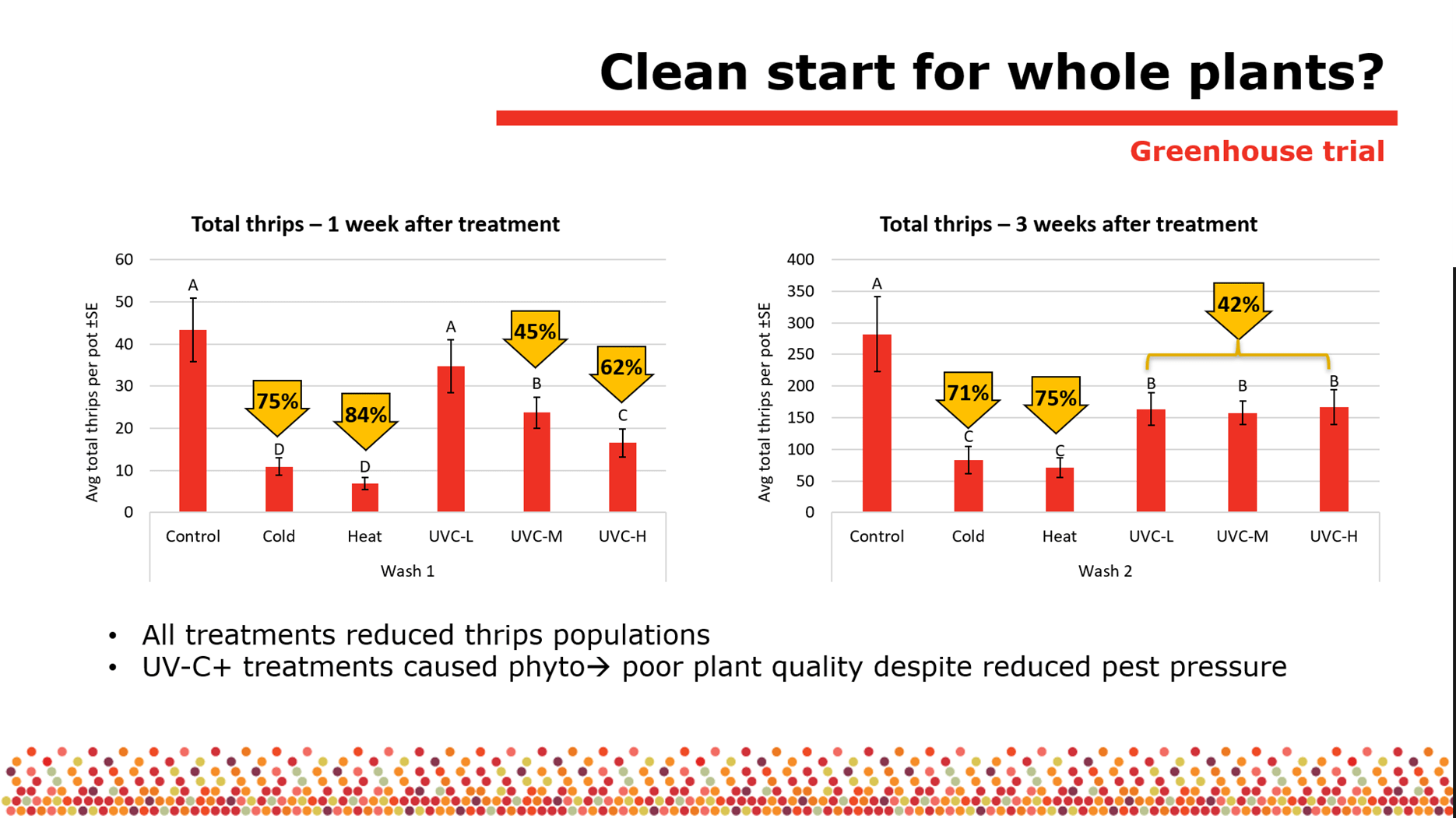
We put this to the test in a greenhouse trial in which infested young mandevilla plants were treated either with 3 days in a cooler at 3°C, or the steam-heated chamber. One week after treatment, the cold and heat treatments reduced the thrips population on whole plants by 75% and 84% respectively (Fig. 3). Three weeks after treatment the cold- and heat-treated plants still looked healthy and productive, while the untreated controls were already destroyed.
The primary drawback of both cold and heat treatment is equipment. Though coolers are readily available to growers, our previous tests confirmed that a typical 8°C is not sufficiently cold to cause mortality, so a second 3°C cooler would be necessary. The heat treatment (Moleda’s Plantsauna) is a pricey investment that growers may be unwilling to shell out for until further demonstration trials can prove it’s worth the price tag.
Reminder: test before you treat!
Every pesticide label cautions growers to test a small area of their crop first, and so we might have become inured to this warning. However, it is a critical step, especially when implementing new protocols such as dipping, cooling, or heating.
The thing that makes dips so effective (total immersion in the pesticide solution) is the same thing that can exacerbate phytotoxicity above and beyond what you would expect from a spray application. We only tested a few varieties in our trial, which were conducted during the winter. Other varieties and different growing conditions may result in more phytotoxicity than we saw in our trial.
Though we saw no signs of phyto in our own trials, cold and heat treatments are a new method that still need more widespread testing before we can safely use them on an entire crop. A keen grower who saw our preliminary cold treatment data at CGC 2 years ago decided to test this approach on their farm, resulting in a few trays of very dead cuttings – a testament to the necessity to test before you treat!
If you are unsure of how to properly perform this kind of test, we’ve put together a guide to on-farm trials that uses cutting dips as its example (A Grower’s Guide to On-Farm Trials).
Vineland and Moleda are interested in conducting more extensive testing and on-farm validation trials with commercial Plantsauna equipment. If you are interested in contributing to and participating in a Plantsauna trial, please contact Dr. Rose Buitenhuis (rose.buitenhuis@vinelandresearch.com).


Comments
Post a Comment