Thrips parvispinus Webinar 3: Attacking Parvi from All Sides

This post was written by Jessie deHaan (Research Technician, Vineland Research and Innovation Centre) and Dr. Sarah Jandricic (Greenhouse Floriculture Specialist, OMAFA).
Part 1 of the three-part webinar series on Thrips parvispinus focused on controlling incoming thrips on cuttings, while Part 2 shared the interesting behaviour and ecology that we’ve learned about Thrips parvispinus (Parvi) that could help us better manage this pest.
The final webinar is all about exploring Parvi IPM in greenhouse trials. Combining biologicals, chemical applications and other IPM interventions throughout plant production may help give you the best footing against Parvi – and other concurrent pests – while avoiding pesticide resistance.
Read on for the link to the webinar and for our written summary.
FCG Parvispinus Webinar 3: Recorded July 2026
Don’t have time to watch the whole webinar? Below we summarized the work done by members of the Biological Crop Protection Lab at the Vineland Research and Innovation Centre, Avery Johnson (M.Sc. student at the University of Guelph), Dr. Rose Labbe (Entomologist, AAFC-Harrow), along with Dr. Sarah Jandricic (OMAFA), who’s worked with growers in the field.
Are All Parvi Made Equal?
One thing that could complicate control of Thrips parvispinus is genetic diversity. In western flower thrips, different populations can have different responses to things like chemical controls, sticky card colour, host plants, and other factors that influence control – and frustrate growers.
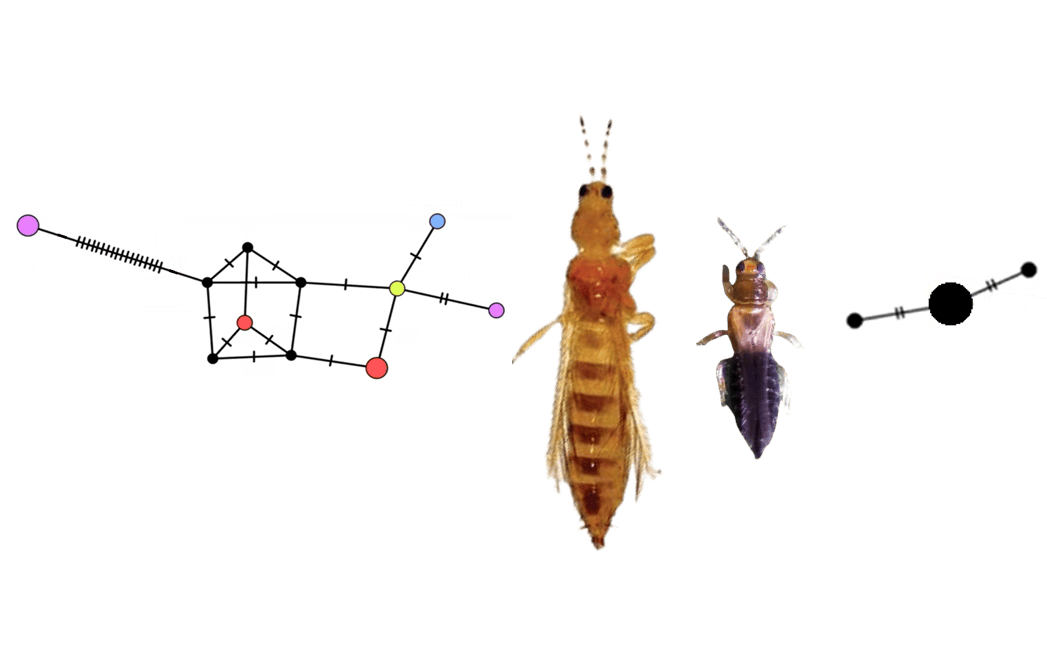
Avery Johnson, an M.Sc. Student working under Dr. Rose Labbe (AAFC) found that although western flower thrips in different crops in Ontario can be quite genetically diverse, Parvi was not (Figure 1). This confirms findings by the University of Florida.
Biocontrol Control Tests Against Parvispinus
Recall that maintaining an effective thrips IPM program requires targeting multiple life stages (larvae, adults, pupae) in multiple locations on the plant (flowers, leaves) and in the substrate. For non-pesticide strategies (i.e., biocontrol) for Parvi, we’ve split the approach into substrate-based controls and foliar biocontrol, to better understand how each contributes to Parvi management, and where your biocontrol dollars are best spent.
Substrate-based Controls
Substrate-focused inputs target the pupal stage of thrips in the soil. Stratiolaelaps scimitus (previously known as Hypoaspis) and Dalotia coriaria (previously known as Atheta) showed inconsistent results against Parvi in lab trials conducted by Vineland. Though both predators were shown to eat Parvi in lab trials from the University of Florida and Wageningen University, both failed to reduce the number of emerging adults in Vineland’s lab trial compared to the control. Whole -plant greenhouse trials are underway to validate their efficacy under greenhouse conditions.
LalGuard M52, meanwhile, demonstrated high viability and surprising persistence in the soil in Vineland’s trials. Following a single application of microbial biopesticides to the substrate (including BioCeres WP, BotaniGard ES, Lalguard M52 OD, Mycotal WP,and Principle WP), the number of living spores was determined from biweekly substrate samples. Their virulence (i.e. ability to cause death) was also tested using waxworms at 8 & 12 weeks after application.
Although all products tested were recovered from the substrate for up to 12 weeks, only Lalguard M52 maintained high spore density. At 12 weeks after application, Principle WP and LalGuard M52 both showed moderate to high virulence (killing 75% and 95% of our waxworm test subjects, respectively).
Foliar Biocontrol
The use of foliar biocontrol agents will affect larval and adult stages of Parvi. In Vineland’s trials, we tested 2 promising “big bios” (Anystis baccarum and Orius insidiosus) combined with microbials (LalGuard M52 OD or BotaniGard ES). Previous on-farm trials by Dr. Sarah Jandricic (Greenhouse Floriculture IPM Specialist) indicated that common predatory mite-based thrips programs aren’t effective for Parvi in many tropical ornamentals, but bigger bios, along with oil-based microbials, showed promise.
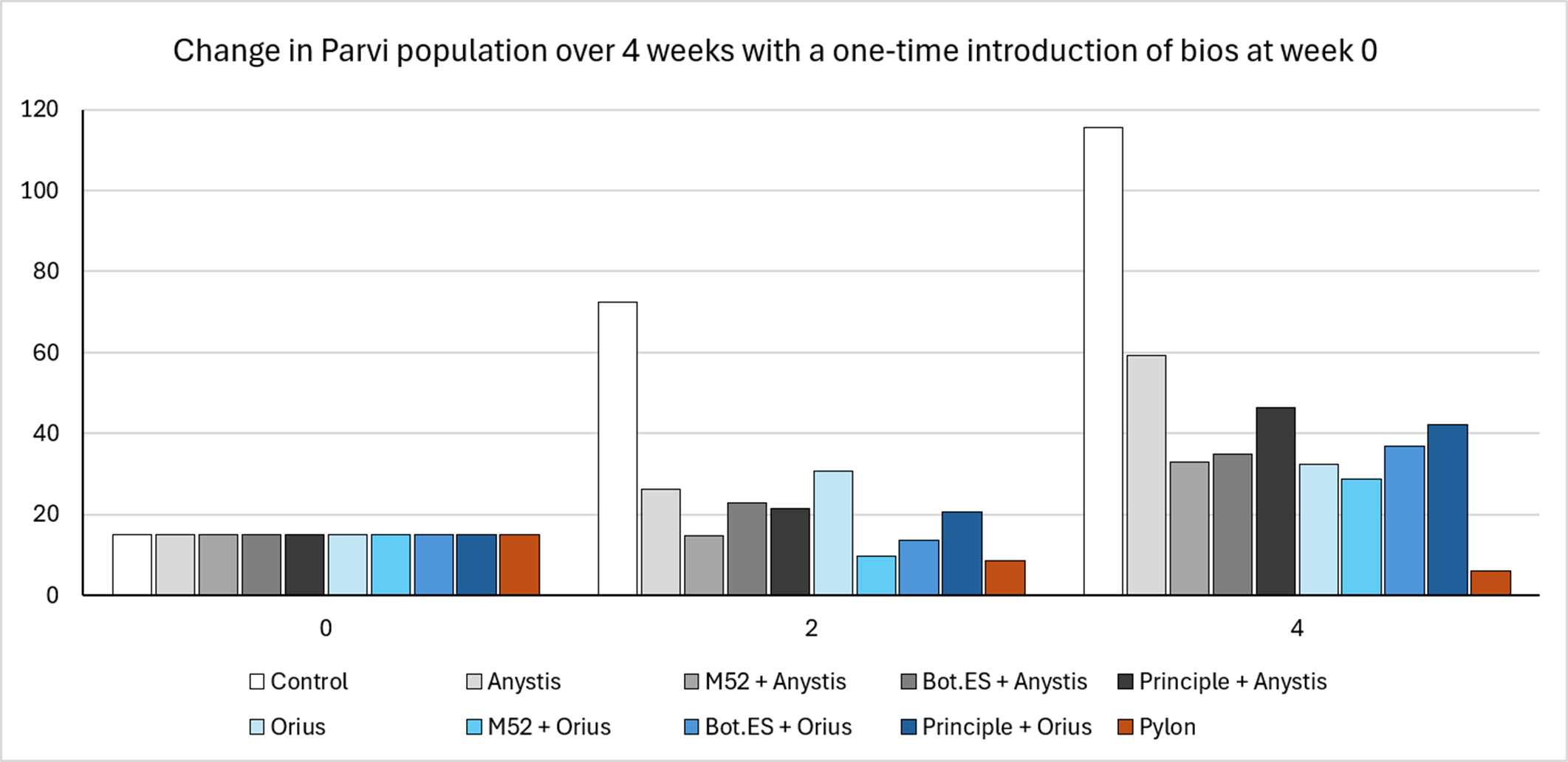
Vineland’s results revealed that applications combining a single release of a foliar “Big Bio” with two sprays of microbial pesticides, particularly Lalguard M52 OD, proved to be nearly as effective as the chemical standard for the first two weeks (Figure 2).
However, these biological inputs lack the 4-6 week residual efficacy and quick knock-down effect of Pylon. So, it’s necessary to continue weekly releases of these “Big Bios” to maintain effective long-term control, or Parvi will overwhelm and destroy the sensitive growing tips in mandevilla.
Suggested IPM Program for Parvi in Tropicals
At this point in the joint research project on Parvi control, Dr. Sarah Jandricic has put together some recommendations on where we can add bios to an IPM program now. Effective IPM programs in crops like Mandevilla will require a layered approach long-term. This is especially true now that growers have witnessed a resurgence in pesticide-resistance in two-spotted spider mites, meaning adding biocontrol agents will be a necessity.
Along with dips in propagation, as discussed in Part 1 of this blog series, Sarah suggests several “pesticide free windows” in mandevilla production where bios could be effectively used. These include adding Orius or Anystis immediately after potting for Parvi larvae and adults, after adding Lalguard M52 to your pots to help control Parvi pupae long-term. This is also where you should start to release predatory mites for two-spotted spider mite to avoid the pesticide resistance treadmill with that pest.
You can view her full recommendations for mandevilla in her 4-part blog series on managing Parvi in Mandevilla (Part 1, Part 2, Part 3, with Part 4 coming soon!)
Summary
The research teams at OMAFA, AAFC and Vineland have been hard at work testing existing biocontrol solutions against Parvi in both foliar and soil applications. Future trials will help clarify early lab results by validating them in a greenhouse setting. Here are the key highlights of what we’ve learned so far:
- Parvi populations in Ontario are not showing any genetic diversity (yet!).
- Soil-based predators have not proven effective in lab trials but still need to be evaluated in greenhouse trials before we can completely discount them.
- Drench applications of microbials persist and remain active for several weeks after application, with LalGuard M52 performing the best of the products tested.
- Combining “Big Bios” (Anystis or Orius) with foliar applications of biopesticides (Lalguard M52 or BotaniGard ES) were nearly as effective as Pylon, but lack long-term residual efficacy, therefore requiring ongoing applications.
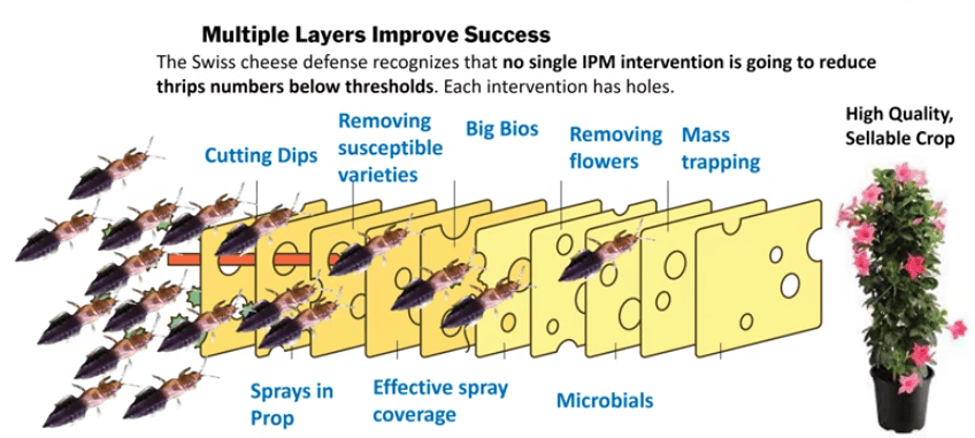
It’s important to note that your response to Parvi may need to be adjusted for each crop that it infests. No single IPM intervention will reduce Parvi numbers long-term on its own (Figure 3). But, together as a whole, a program combining chemical and biological applications will have a good impact. Programs may require incorporating other tools in the IPM toolbox such as selection of resistant varieties, mass trapping and even removing flowers to reduce Parvi numbers.
This project is supported by Agriculture and Agri-Food Canada under the AgriScience Program, an initiative of the Sustainable Canadian Agricultural Partnership.e IPM Specialist, OMAFA)


Comments
Post a Comment